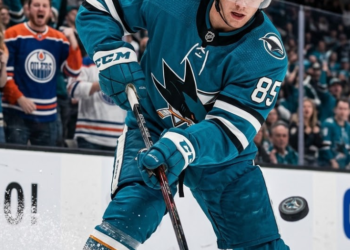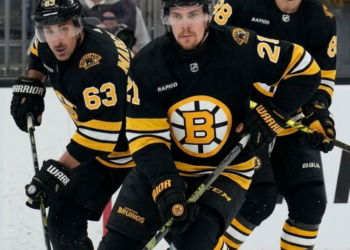
For Marco Kasper, this is the finest result.
When life gives you lemons, they say you should create lemonades. For the Detroit Red Wings, more possibilities for Marco Kasper, a first-round selection, might be just what the team is looking for.
In 81 games during the 2025-26 season, Marco Kasper only recorded 19 points, making it a horrible year. Last season, an NHL center’s average shooting percentage was roughly 12.8%. Kasper’s performance was approximately 6.9 percent, which is half of what a typical center would be successful at.
A persistent knee injury, which hindered his output all year, may be partially to blame for this. Another cause might be a mix of factors, such as high expectations after a successful first season and a lack of self-assurance.
This time around, Kasper has a new lease on life, a whole summer’s worth of training, and a team in desperate need of a hero.
There is arguably no other player on the Red Wings who is better positioned for success than Marco Kasper.
Kasper may labor in silence because to Chaos.
There was a lot of drama during the offseason. There doesn’t seem to be any indication that the craziness will stop, from Dylan Larkin’s trade request to Steve Yzerman’s unexpected exit. In actuality, this might be very beneficial to Kasper. Kasper may now go about his business without any more distractions since the media attention has switched to Larkin, Chris Ilitch, and Shawn Horcoff.
If Larkin misses too much time, Kasper may need to take on more responsibility in the middle. Between Emmitt Finnie and new addition Viktor Arvidsson, he is listed on the second line in current roster predictions. While this combination does not have the offensive oomph of the wingers on the top line (Alex DeBrincat and Lucas Raymond), it might be seen as an audition for Kasper.
Kasper may be given a time share on the first line if he demonstrates his ability to manage challenging, top-six minutes.
How Kasper can succeed
Kasper was able to contribute in other ways despite last season’s low offensive production. Even with an average of 13:48 per night of playing time, he was the team’s top hitter. Kasper was able to physically establish himself, whether by making huge tackles to open up passing lanes or by putting his body to good use, even though he played up and down the line.
There’s a possibility the Red Wings might develop him into a power forward if he is able to put in the effort to create offensively.
Kasper may play a similar role to that of David Backes, a former NHL player, or Sam Bennett of the Florida Panthers. The squad will prosper if he can work things out offensively. Luckily, it seems that he has a good chance of succeeding. Even if the numbers didn’t appear on the scoresheet, advanced analytics seem to suggest that he’s a valuable member of the Red Wings on both sides of the ice.
However, it will totally depend on factors outside Kasper’s control in terms of season ending numbers. Kasper will receive all the top-six ice time he can handle if the Red Wings deal Larkin sooner rather than later. Larkin may have to fight Andrew Copp for the second line center spot if he returns and the issue persists.
In any case, it’s reasonable to believe that Kasper will be a strong rebound player for the Red Wings this season.